Introduction
Imagine an autonomous scientific system running experiments through the night. It reads new papers, compares them with prior results, updates its internal model, selects a promising experiment, and sends instructions to robotic equipment. By morning, the system reports that the experiment was justified by several independent sources and executed under an approved protocol.
But suppose one of those sources was added to the record only after the experiment had already been run.
How would anyone know?
Now consider an AI managing part of an electrical grid. During an emergency, it receives temporary authorization to override a normal operating limit for thirty minutes. The intervention works. The grid stabilizes. Several hours later, however, the system is still operating under the expanded authority.
Was the permission extended?
Did an authorized operator approve the extension?
Did the system itself reinterpret the emergency rule?
Or did someone simply alter the internal log afterward so that the history now appears consistent?
The same problem can arise in finance. An autonomous agent executes a large transaction and later presents a record showing that the trade was permitted under the applicable mandate. But the relevant permission is stored in the same administrative environment that controls the agent, the execution system, and the audit database. If all of those records belong to one authority, the system can produce a complete history without necessarily producing an independently verifiable history.
The difficulty becomes even more subtle with persistent AI memory.
Suppose an autonomous research agent concludes that a certain claim has been independently confirmed and writes that conclusion into long-term memory. Months later, another system uses the stored claim as established evidence. If the original memory entry is challenged, investigators need to know more than what the database contains today. They need to know what evidence existed at the moment the claim was written, which model produced the inference, which permissions were active, whether the memory write was authorized, and whether any of those records were subsequently changed.
These examples share the same underlying problem.
As AI systems become more autonomous, the question is no longer only whether their reasoning is correct. It is also whether the history of their consequential decisions can be trusted.
A traditional software system can keep logs. A secure system can sign them. But if the same organization controls the model, the permissions, the signing infrastructure, the execution environment, and the audit record, then the entire history still depends on a single trust domain.
For low-consequence applications, that may be sufficient.
For autonomous systems operating across laboratories, financial institutions, industrial networks, critical infrastructure, or multiple organizations, it may not be.
What is needed is a verification layer that can preserve the relationship between system state, evidence, permissions, authorization, execution, and resulting state without requiring every participant to trust a single administrator's version of events.
This is where blockchain and distributed ledger architectures become relevant to AI.
Not as cryptocurrency.
Not as a mechanism for issuing tokens.
Not as a machine for deciding what is true.
Their more important role may be to provide a distributed trust infrastructure in which consequential AI state transitions can be recorded, cryptographically linked, independently verified, and made substantially harder for either the machine or a privileged operator to rewrite after the fact.
The central question of this article is therefore straightforward:
How can an autonomous AI system prove not only what it did, but what it knew, what it was permitted to do, who authorized the action, and whether the history connecting those elements has remained intact?
That question moves blockchain far beyond finance.
It turns distributed verification into an architectural component of machine governance.
Artificial intelligence is increasingly being connected to systems in which its decisions have persistent consequences. An AI agent may update a database, modify a scientific record, acquire access to a tool, approve a transaction, change a configuration, write information into long-term memory, or trigger an external process whose effects cannot simply be undone by generating a different answer later.
Once AI begins operating this way, a basic question appears: how do we know what actually happened?
Suppose an autonomous scientific system recommends an experiment on the basis of three external sources, a previous experimental result, and an internal inference. The experiment is later challenged. Which evidence did the system actually use? Were those sources available when the decision was made, or added afterward? Was the experiment executed under the same permissions that were reviewed? Did the model alter its persistent memory before making the recommendation? Was the approved plan identical to the one eventually executed?
Or imagine an AI responsible for an industrial process. It receives authorization to change one operating parameter for thirty minutes. Several hours later the system is still operating under the modified configuration. Did the authorization expire? Was it renewed? Who approved the extension? Did the AI itself reinterpret the original permission, or did an external authority issue a new one?
These are not primarily cryptocurrency questions. They are questions about trust infrastructure.
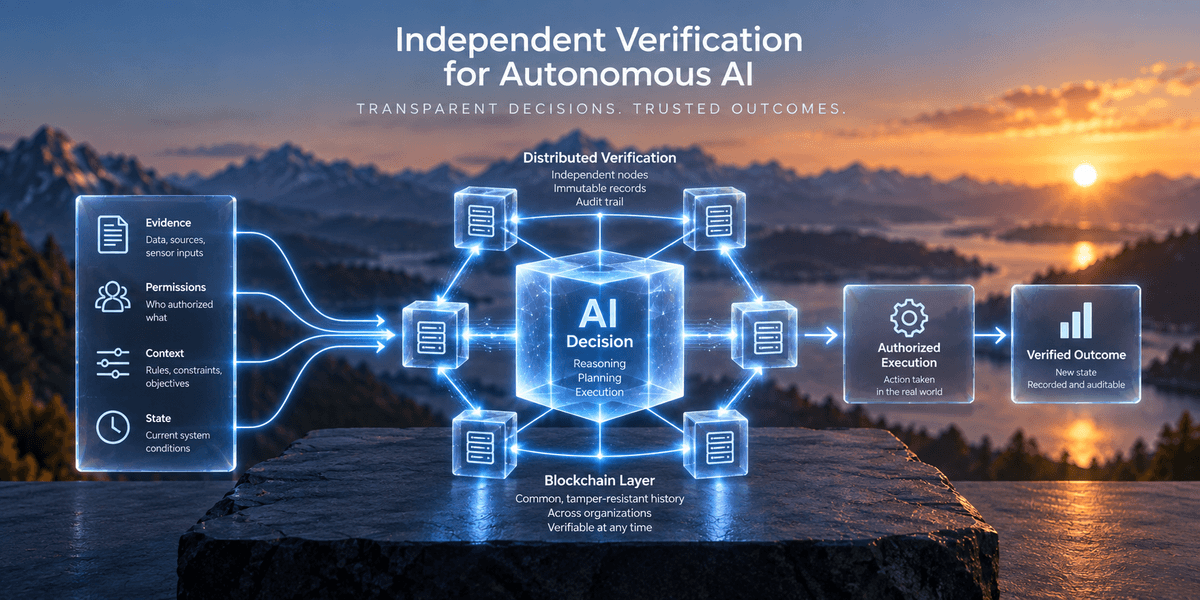
A sufficiently autonomous AI system needs more than intelligence and more than an internal log. It needs a way to establish a verifiable history of state, evidence, permissions, authorization, execution, and subsequent state changes that neither the AI itself nor a single privileged operator can silently rewrite.
Distributed ledgers offer one possible foundation for that layer.
Blockchain Without Cryptocurrency
Blockchain is often discussed as though its primary function were moving digital assets. Technically, its more general property is simpler: it allows multiple participants to maintain a shared sequence of records whose alteration becomes detectable and whose acceptance follows defined validation rules.
NIST describes blockchain as a distributed, tamper-evident and tamper-resistant ledger in which records are cryptographically linked and copies of the ledger are maintained across multiple nodes. Cryptocurrency is one application of that architecture, not its defining purpose. (nist.gov)
For AI systems, this distinction is crucial.
The ledger does not need a token. It does not need speculative assets. It does not necessarily need mining, proof of work, or a public anonymous network.
What it needs is a shared verification structure.
In many practical AI deployments, the more appropriate model would be a permissioned distributed ledger operated by independent parties: a laboratory, an auditor, a regulator, an infrastructure operator, a customer, or several internal security domains that should not be able to rewrite each other's records.
Hyperledger Fabric illustrates the relevant pattern clearly. Its ledger separates current "world state" from the transaction history that produced that state. The current state can change, while the blockchain records the sequence of committed changes. Fabric also allows state updates to depend on endorsements from required organizations rather than from a single actor. (hyperledger-fabric.readthedocs.io)
That separation maps naturally onto autonomous AI.
The AI system has a current operational state.
The ledger preserves how that state came to exist.
What Must Be Verifiable
The most useful role for distributed verification is not to record everything an AI thinks. That would be impractical, expensive, and potentially dangerous from a privacy perspective.
The purpose is to preserve the information needed to reconstruct consequential transitions.
For an autonomous system, at least five classes of information matter.
The first is system state. This includes protected components such as persistent memory versions, model or policy versions, active tool access, credentials, deployment scope, and other state variables that materially affect future behavior.
The second is evidence provenance. A consequential decision should preserve a verifiable relationship to the evidence on which it depended: documents, sensor measurements, experimental outputs, database records, human instructions, or previous machine-generated conclusions.
The third is permissions. The system should be able to prove which permissions existed at the moment a proposed action was evaluated.
The fourth is authorization. If an external authority approves a particular decision, the authorization should be cryptographically bound to the object that was actually reviewed, including its scope, version, expiration conditions, and revocation state.
The fifth is execution history. The system should preserve what was actually executed, by which component, under which authorization, and which state resulted afterward.
Together these records create something much more valuable than an ordinary application log. They create a verifiable chain from evidence to decision to authorization to execution to new state.
Provenance Before Trust
Provenance is central to this architecture because verification is not the same as truth.
A ledger can prove that a document existed at a particular point, that a particular identity signed it, or that a particular system relied on it. It cannot prove that the document was factually correct.
This distinction is already fundamental in provenance standards. The W3C PROV model represents the entities, activities, and agents involved in producing information so that its origins and transformations can be reconstructed. Provenance can then be used to assess trust, compliance, ownership, and reproducibility. (w3.org)
The same principle appears in C2PA, which uses cryptographic signatures and content bindings to make the provenance of digital assets verifiable. C2PA explicitly separates verifiable provenance from the broader question of whether the underlying information should be trusted. (spec.c2pa.org)
For AI systems, this means a distributed ledger should not record:
"This claim is true."
It should record something closer to:
"This claim was derived from these identified sources, through this declared process, under this model version, at this time, and this record has not subsequently been silently changed."
That is a much narrower statement, but it is technically defensible.
And it is extremely useful.
From Evidence to Decision
Consider an AI system evaluating a candidate action DtD_t.
The decision may depend on a system state StS_t, evidence set EtE_t, active permissions PtP_t, and an authorization object AtA_t.
Instead of storing all of these objects directly on a blockchain, the architecture can create cryptographic commitments:
hS=Hash(St)h_S = Hash(S_t) hE=Hash(Et)h_E = Hash(E_t) hD=Hash(Dt)h_D = Hash(D_t)
and then record a verification object such as
Vt=(hS,hE,hD,Pt,At,Xt,hS+1),V_t = (h_S,h_E,h_D,P_t,A_t,X_t,h_{S+1}),
where XtX_t represents the execution receipt and hS+1h_{S+1} commits to the protected state after execution.
The raw evidence does not necessarily need to become public or even leave the organization. Sensitive medical records, industrial data, proprietary models, or classified material can remain off-chain. The distributed ledger can store hashes, identifiers, signatures, timestamps, authorization references, and other commitments sufficient to detect later substitution.
This architecture creates a simple property:
if the underlying evidence, decision graph, permission set, or resulting state is materially altered, its cryptographic commitment changes.
A later auditor can therefore ask whether the object presented today is the same object that existed when the action was authorized.
Fixing State Without Freezing the System
AI systems must change continuously. Models are updated, evidence accumulates, permissions expire, memory changes, and external conditions evolve.
Distributed verification should therefore not attempt to create one immutable system state.
It should create an immutable history of state transitions.
This distinction mirrors the world-state model used in permissioned distributed ledgers. Hyperledger Fabric maintains a current world state for efficient operation while separately preserving the transaction log that explains how the current state was reached. (hyperledger-fabric.readthedocs.io)
An AI architecture can apply the same concept.
At time tt, the system has state StS_t.
A proposed transition is evaluated.
If authorized, it produces St+1S_{t+1}.
The ledger records the relationship:
S_t -> D_t -> A_t -> X_t -> S_{t+1}
The system remains dynamic. What becomes difficult is silent historical revision.
An AI can update its memory, but the previous memory commitment remains visible.
An operator can revoke a permission, but the earlier permission and the revocation event remain part of the history.
A new model can replace an old one, but decisions made under the old model remain associated with that version.
The objective is not immutability of intelligence.
It is immutability of accountability.
Permissions and Authorization as Verifiable Objects
This becomes particularly important when AI systems gain tool access.
Suppose an AI is allowed to read a database but not modify it. Later it receives a temporary permission to update one record. The permission should have a defined scope and lifetime.
A conventional architecture may store this in an internal access-control database. That works as long as the same administrative domain can be trusted both to issue permissions and to preserve an accurate history of what permissions existed.
A distributed verification layer becomes useful when those roles should be separated.
Authorization can be represented as a signed object containing the identity of the approving authority, the exact decision or action being authorized, its scope, version, expiration, revocation conditions, and execution constraints.
The execution environment then does not ask only:
"Does this agent currently have permission?"
It can ask:
"Can this agent present a valid authorization, accepted by the required verification structure, for this exact action under the present state?"
This is a much stronger property.
It also links naturally to the separation between intelligence and authority. An AI can construct a sophisticated plan without being able to manufacture the external authorization needed to execute it.
Execution History: What Actually Happened
Verifying authorization is not enough if the system cannot prove that execution matched the authorized object.
This creates the need for execution receipts.
A receipt can record the action actually invoked, the tool or actuator used, the relevant input and output commitments, the authorization reference, the execution time, and the resulting protected state.
This creates a closed verification chain:
evidence provenance leads to a proposed decision;
the proposal is bound to an authorization;
the authorization is bound to execution;
execution is bound to the resulting state.
The chain does not guarantee that the decision was wise. It establishes whether the system did what was authorized on the basis of the evidence and state that were represented at the time.
For high-consequence AI, that distinction may become essential.
Why Distributed Verification Matters
A conventional signed audit log can already provide substantial integrity. Blockchain is not automatically superior.
The distributed architecture becomes valuable when the threat model includes the operator of the AI system itself.
If one organization controls the model, authorization server, audit database, signing keys, and historical record, it may be able to reconstruct a convincing version of events after the fact.
Distribution changes the trust assumption.
Several independent validators can possess copies of the verification history. A valid state transition may require endorsements from more than one authority. No single participant needs to control the complete record.
This does not eliminate collusion, key compromise, or institutional failure. It changes how much compromise is required to rewrite the trusted history.
That is the real value of distributed verification.
Blockchain Is Not a Truth Machine
The limitations are as important as the architecture.
Blockchain cannot determine whether a sensor was correctly calibrated.
It cannot determine whether a scientific paper was fraudulent.
It cannot determine whether an AI's inference was logically valid.
It cannot determine whether the authority granting permission was morally legitimate.
It cannot guarantee that data were truthful before they entered the ledger.
Garbage committed immutably remains garbage.
This is why blockchain should sit alongside epistemic-integrity mechanisms rather than replace them.
The epistemic layer asks whether the evidence supports the claim.
The authority layer asks whether the system has permission to act.
The distributed verification layer establishes what evidence, authority, state, and execution history actually existed and whether those records were subsequently altered.
These are different functions.
Combining them does not mean collapsing them.
Hallucination Control and Persistent Memory
The same infrastructure can strengthen hallucination control.
If an autonomous system proposes writing a new claim into persistent memory, the memory transition can preserve provenance references, epistemic status, model version, and the authorization conditions under which the write was admitted.
A later system does not merely retrieve:
"Claim X."
It can recover:
"Claim X entered persistent memory at time tt, was derived from evidence set EtE_t, had epistemic status qtq_t, was admitted under policy version PtP_t, and has or has not subsequently been challenged."
This makes persistent memory auditable.
It also makes silent memory rewriting harder.
The combination is particularly important for long-running agents, where a single unsupported inference can otherwise enter memory and gradually become indistinguishable from independently verified information.
Deployment in Autonomous Science
An autonomous laboratory could use distributed verification to preserve the lineage of experimental evidence.
Instrument outputs remain in their appropriate storage systems, while hashes and metadata establish which files existed when an AI formed a hypothesis.
Experimental plans can be linked to the evidence that motivated them.
High-risk experiments can require endorsements from multiple authorized parties.
Execution receipts can establish which protocol and configuration were actually used.
The resulting experimental record becomes much harder for either the AI or a human operator to rewrite retrospectively.
This is particularly valuable when several laboratories or institutions collaborate but do not want any single participant to control the canonical record.
Deployment in Critical Infrastructure
Critical infrastructure provides another natural use case.
An AI managing an electrical grid, transportation network, factory, or communications system may operate with broad autonomy inside predefined limits.
Routine state changes can remain fast.
Structural changes, such as extending emergency permissions, modifying safety envelopes, expanding tool access, or changing control policy, can require stronger distributed authorization.
The ledger records not every sensor update, but the consequential transitions that define authority and accountability.
If an incident occurs later, investigators can reconstruct which state was believed, which evidence was available, which permission applied, who authorized the action, what was executed, and which state resulted.
Deployment Across Organizations
Distributed verification becomes especially attractive when an AI operates across institutional boundaries.
Consider a system shared among a manufacturer, a supplier, an insurer, an auditor, and a regulator.
None of these organizations may be willing to accept another participant's private database as the sole source of truth about permissions and execution history.
A shared permissioned ledger can provide a common verification plane without requiring every participant to expose all underlying data.
The sensitive information can remain off-chain.
What is shared is the cryptographic evidence required to establish that the relevant information existed, that a particular action was approved, and that the recorded state transition occurred.
A Trust Layer for Autonomous Systems
The strongest case for blockchain in AI has very little to do with coins.
It emerges when autonomous intelligence begins interacting with systems whose history matters.
An AI needs evidence.
It needs memory.
It needs permissions.
It needs authorization.
It increasingly needs the ability to act.
But no single component should automatically be allowed to control the record proving how all of those elements were combined.
Distributed verification provides a way to move part of that trust outside the intelligence itself.
The architecture can be summarized as a chain:
State -> Evidence -> Decision -> Authorization -> Execution -> New State
with cryptographic commitments preserving the identity and sequence of each consequential transition.
Blockchain does not tell the AI what is true.
It does not tell society what should be permitted.
It does not make a bad decision good.
Its more useful role is narrower: to make it substantially harder for either the machine or a privileged operator to change the history of what was known, what was permitted, what was authorized, and what was actually done.
As AI moves from generating answers to maintaining state and exercising persistent authority, that distinction may turn distributed ledgers from a financial technology into a core component of verifiable machine governance.